Heyden Observatory
The Heyden Observatory, a historic site in Washington, DC, was established in 1841. Originally operated by Jesuit scholars, and by students today, it has made significant contributions to our understanding of the universe and educated countless students in astronomy.
In addition to its rich history, the observatory is home to The Garden of the Stars, an installation that creatively merges the themes of astrobiology and environmental stewardship.
History of The Heyden Observatory
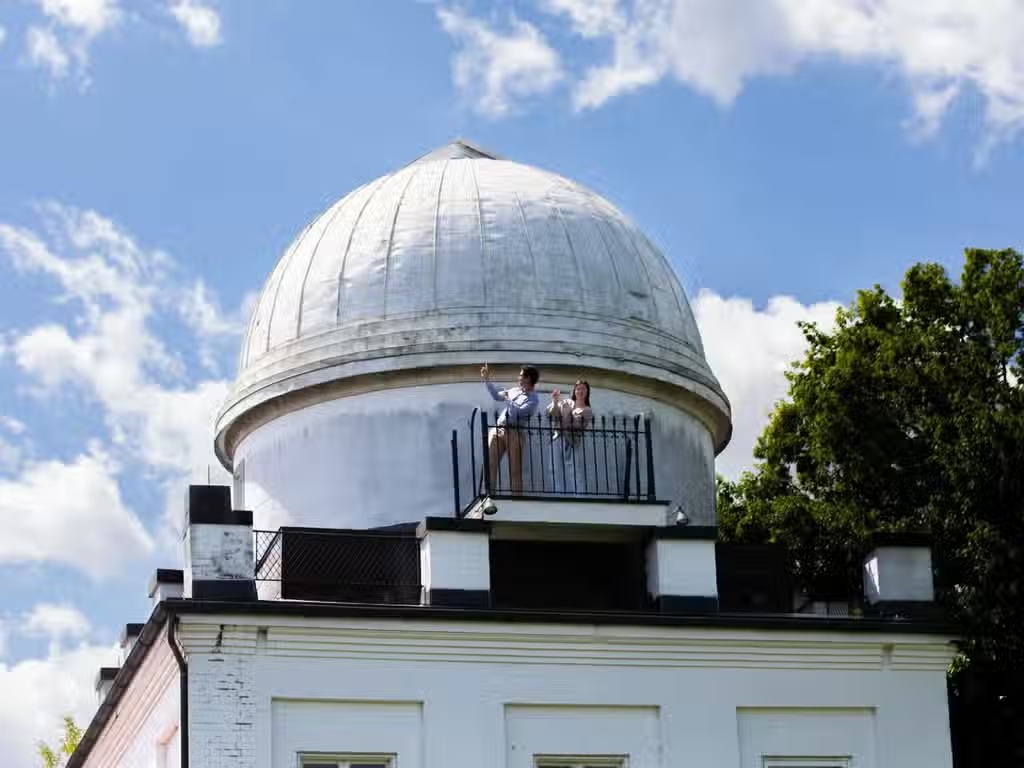
Founded in 1841 as part of a nascent Jesuit observatory network, Georgetown’s Heyden Observatory in Washington, DC, with its rotating dome, library, seismograph and two still-functioning astronomical clocks, has supported over 125 years of astronomical research. From establishing the latitude and longitude of the nation’s capital, which had been previously unknown, to significant breakthroughs in stellar photometry and hosting the research of legendary astronomers, including Jesuit Angelo Secchi, the father of modern astrophysics.
It also undertook groundbreaking work on solar eclipses throughout the twentieth century, spearheading expeditions to far-flung places such as Sudan and refining stellar navigation techniques. Yet the impact of the Georgetown astronomy program was not limited to the observatory itself: it reached far beyond the observatory into the DC and American astronomical communities and into the lives of everyone involved.
Father Francis J. Heyden, S.J.
The arrival of the observatory’s final director, Father Francis J. Heyden, S.J., following World War II, embodies this impact. He expanded the graduate program to involve more than 90 doctoral candidates, hosted student researchers from local high schools and colleges, taught graduate and undergraduate astronomy courses, and spoke at schools in the area, all while simultaneously managing Georgetown’s student radio station and hosting astronomical conferences on campus.
A national landmark
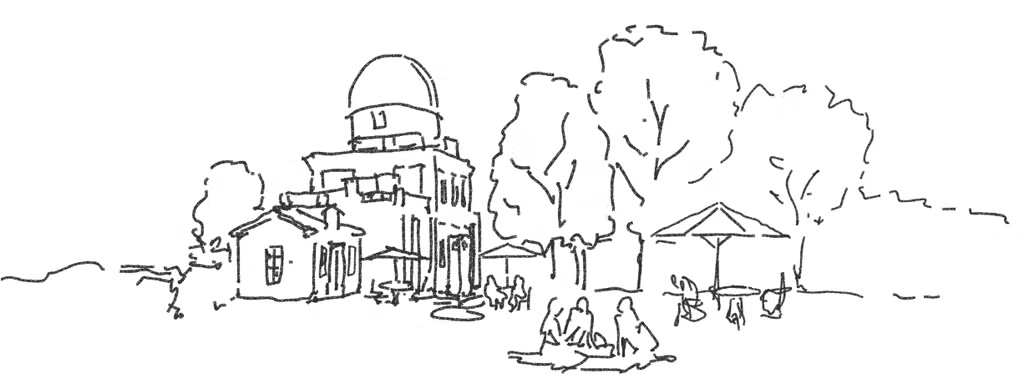
The Heyden Observatory represents a unique part of American history. Founded and operated by Jesuits for over a century, it is listed on the National Register of Historic Places and is the oldest continuously operating observatory in the United States. In 1969, an act of Congress designated the Heyden Observatory a National Landmark.
Notable students
Father Heyden’s research focused mainly on solar eclipses for geodetic purposes and planetary spectroscopy. But perhaps even more than research, Father Heyden dedicated his time and energy to the astronomy students, among them Vera Rubin, the discoverer of dark matter; John P. Hagen of Project Vanguard; and a generation of Jesuit astronomers, including Martin McCarthy, George Coyne and Richard Boyle.
Georgetown University Astronomical Society
Following the closure of the astronomy department in 1972, the Georgetown University Astronomical Society emerged to continue its educational and outreach work in the absence of a departmental framework. In 1987, almost 150 years after its founding, Georgetown College Observatory was rededicated in Father Heyden’s name.
The Garden of the Stars
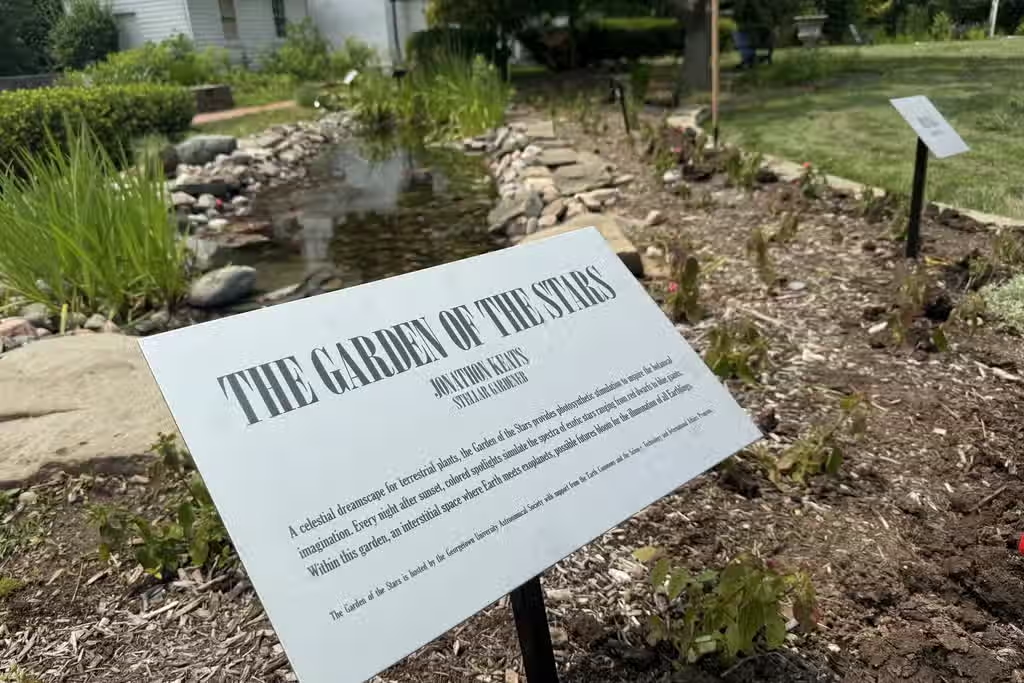
The Garden of the Stars, located on the grounds of Georgetown’s historic observatory, is an installation at the intersection of astrobiology and environmental stewardship, an interstitial space where life as we know it meets conditions that might support life elsewhere in the universe.
Educational experience
The garden provides a scientific learning opportunity for visitors and an impetus to celebrate life on Earth, integrating ecology with the vast cosmos and encouraging participants to care for our precious common home.
Concept and design
The garden has been landscaped with an eclectic assortment of charismatic plant life and spotlights. The wavelengths of light correspond to the main sequence stellar classes and colors. The first stop represents M-type stars, with a red solar-powered spotlight and signage describing this stellar class. The subsequent stops continue with the rest of the main sequence star classes, with spotlights set to the peak wavelengths of those star classes.
The concept was conceived by Jonathan Keats, an artist-in-residence at the Search for Extraterrestrial Intelligence (SETI) Institute. Keats is a conceptual artist and experimental philosopher known for creating large-scale thought experiments.
Featured news
-
Garden of the Stars
When students returned to Georgetown this fall, many stepped into new spaces and new buildings across campuses. The university opened residences for junior and seniors on the Hilltop Campus and…
-
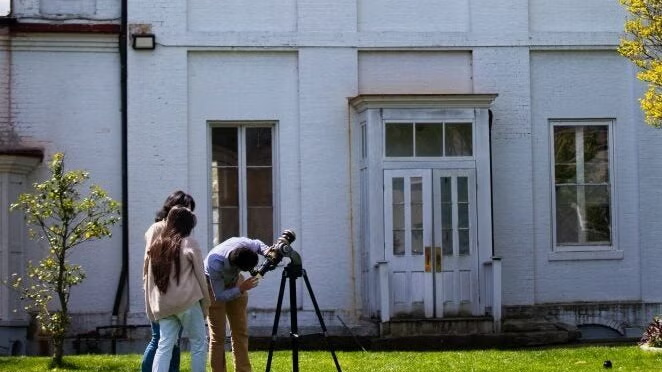
The Caretakers of the Observatory: Lifting Off With Georgetown’s Astronomical Society
On any clear Tuesday night on a hilltop that overlooks the Hilltop, you may notice students gathered outside the Heyden Observatory with telescopes pointed to the heavens.
-
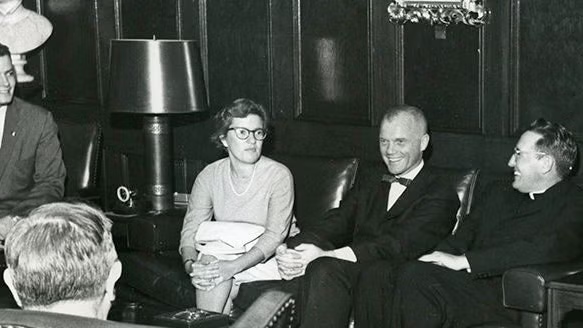
Observatory Named for Georgetown Physicist Who Encourages Next Generation of Women in Science
Sarah Jiang (C’21) says she’s thrilled that the National Science Foundation chose to name a telescope designed to conduct “a vast astronomical survey” after Vera Rubin (G’54), the renowned Georgetown…