Research
Discover multidisciplinary space research.
Georgetown University faculty actively conduct research in space studies, focusing on critical areas such as space law, biosignatures, human health and the application of emerging technologies for space security.
These interdisciplinary projects aim to advance our understanding of space and address the challenges posed by human exploration beyond Earth.
In NASA funding
Secured by Georgetown’s tenure track faculty in the last decade.
Peer reviewed space articles
Published by Georgetown University faculty in the last decade.
Research projects
Browse the research projects that faculty members at Georgetown University are actively engaging in to explore space-related challenges.
Current space research projects at Georgetown University
Space Law and Policy
The “Space Law and Policy” project at the Center on National Security at Georgetown Lab seeks to address the rapidly evolving space domain and the legal frameworks that guide the many stakeholders and national security challenges involved. As both public and private actors expand their presence beyond Earth, the project explores how to balance innovation, security, and sustainability in orbit.
NASA’s Orbiting Carbon Observatory-2
Remote sensing has long been used to monitor agriculture across large areas, helping farmers make better decisions about how to increase yields, optimize irrigation, and maintain soil quality. New satellites, taking data with increasing spectral and spatial resolution, are providing more advanced insights into the health of plants around the world, including crops. Using solar-induced fluorescence (SIF) data from NASA’s OCO-2 and other satellites, the Jones Lab explores whether faint signals from crops in satellite measurements could be the next great tool for precision agriculture.
Searching for Life Beyond Earth
The Johnson Lab’s research is driven by the underlying goal of understanding the presence and preservation of biosignatures within planetary environments. The lab is also involved in planetary exploration, analyzing data from current spacecraft, and devising new techniques for future missions.
Laboratory for Agnostic Biosignatures
In the universe, there may be life that is very different from what we’re used to on Earth. How will we know what to look for, and how will we recognize it as life if we’ve never seen it before? The Laboratory for Agnostic Biosignatures (LAB) is working to address these and other questions related to the search for truly alien life, as we’ve never seen before.
Astronaut Health and Space Medicine
Biomedical research and development in space is no longer a purely scientific pursuit—it is a high-potential driver of innovation. As commercial spaceflight shifts from conceptual to operational, ensuring human health in extreme environments is both a biological imperative and a commercial opportunity. Our biomedical research and development team offers targeted expertise in human space biology and radiation medicine.
Center for Security and Emerging Technology
The Center for Security and Emerging Technology studies how emerging technologies, such as artificial intelligence and machine learning, can be effectively used by the U.S. government, especially for space security and exploration. Their research in this area examines AI-enabled emerging technologies relevant to national security, opportunities and challenges for adoption and application, and opportunities for alliances in the development and deployment of AI-enabled systems.
Exploring the Open Ocean
The Helm Lab explores the open ocean, studying floating life at the ocean’s surface. Professor Helm often employs remote sensing approaches and has worked closely with NASA to mobilize citizen scientists and volunteers to collect information across the ocean’s surface and along coastlines through the Global Ocean Surface Ecosystem Alliance (GO-SEA) Project.
NASA Satellite Servicing
NASA’s SSCO (Satellite Servicing Capabilities Office) is working on creating tele-operated robotic satellites that are capable of repairing satellites currently in orbit. This is a hugely important endeavor. There are thousands of satellites in orbit right now, and most of them were built with rapidly obsolescing technology. If we can repair these with new components, as this project endeavors to do, or even refuel them, we can extend their useful lifetimes by many years.
Student research opportunities
Discover a range of exciting research opportunities, including grants and summer programs, in the space field that can enhance your education and career.
Research news
Browse the our news stories about the latest space discoveries from Georgetown University researchers.
-
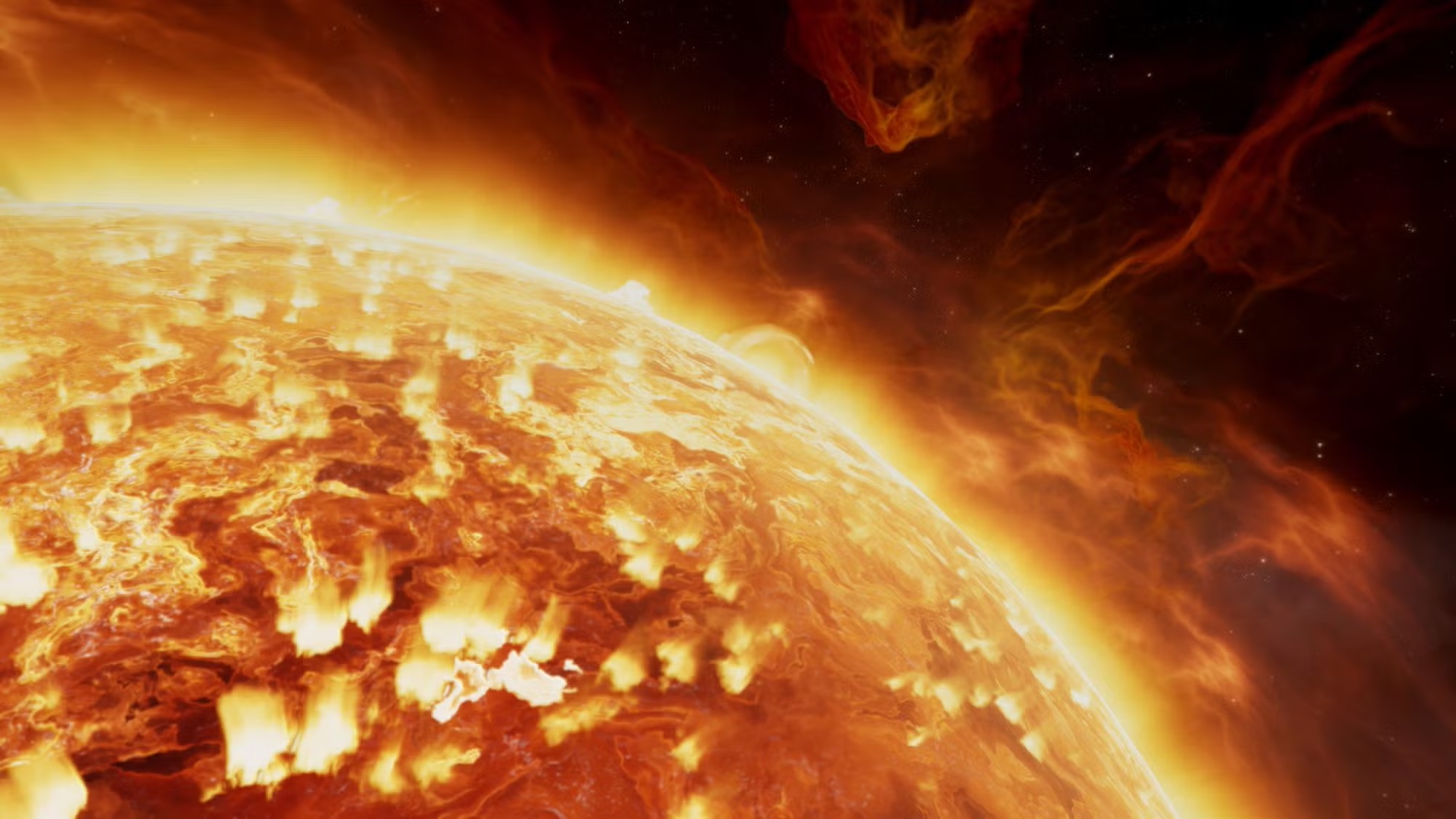
How Space Shapes Human History and Why the Future May Be in Asteroids
This story is a part of our Ask a Professor series, in which Georgetown faculty members break down complex issues and use their research to inform trending conversations, from the…
-
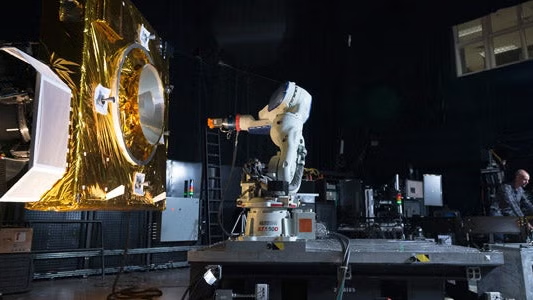
CCT Professor Evan Barba’s Research with the NASA-Satellite Servicing Projects Division
Life on earth has become dependent on orbital satellites. Telecommunications, weather, and imaging satellites provide services and data that we rely on in the course of our daily lives, and…
-

Blinded by the light: How bad are satellite megaconstellations for astronomy?
“We are just beginning to appreciate how bad the disruption can be for land-based and space-based telescopes, and as more and more satellite overflights occur, the problems will only intensify.”