Academics
The last decade has seen a wave of groundbreaking discoveries in space that have reshaped our understanding of the universe.
These include the first-ever image of a black hole, captured by the Event Horizon Telescope, which confirmed key predictions of Einstein’s theory of general relativity. The James Webb Space Telescope has revealed stunning images of distant galaxies and star-forming regions, offering unprecedented insights into the early universe. Continued in situ exploration of Mars and the telescope-based confirmation of thousands of new exoplanets has fueled the search for extraterrestrial life, while medical innovations have made it safer for humans to venture beyond Earth.
Recent years have also ushered in a new era of competition and collaboration in space that is reshaping global affairs. Nations are racing to secure strategic footholds beyond Earth. Space has become a crucial domain for communications, navigation, and deterrence as well as a frontier for innovation and investment. The absence of clear governance frameworks has spurred urgent debates over orbital congestion, resource rights, and security in orbit and beyond. For policymakers, diplomats, and entrepreneurs alike, the emerging space economy demands fluency not only in science and technology but also in law, markets and international relations.
Georgetown’s global perspective and presence in Washington, DC, place students at the crossroads of science, policy and diplomacy, where decisions about the future of space are actively being shaped. Here, students can study alongside world-class faculty engaged with NASA, Carnegie, the Smithsonian, the State Department and leading space companies, gaining both technical literacy and strategic insight. With unparalleled access to policymakers, industry leaders, and international institutions, Georgetown offers a front-row seat to the unfolding story of humanity’s expansion into space and the tools to help lead it.
STIA Space Concentration
The Space Studies concentration in the SFS undergraduate major in Science, Technology and International Affairs (STIA)—newly approved—explores the rapidly expanding role of outer space in global affairs, examining how science, technology, policy and security intersect beyond Earth.


Courses
Georgetown University offers a diverse array of courses in space studies that cover policy development, environmental science, biology, law and technological advancements in space exploration. Explore the various options available to enhance your understanding of this dynamic field.
Featured news
-
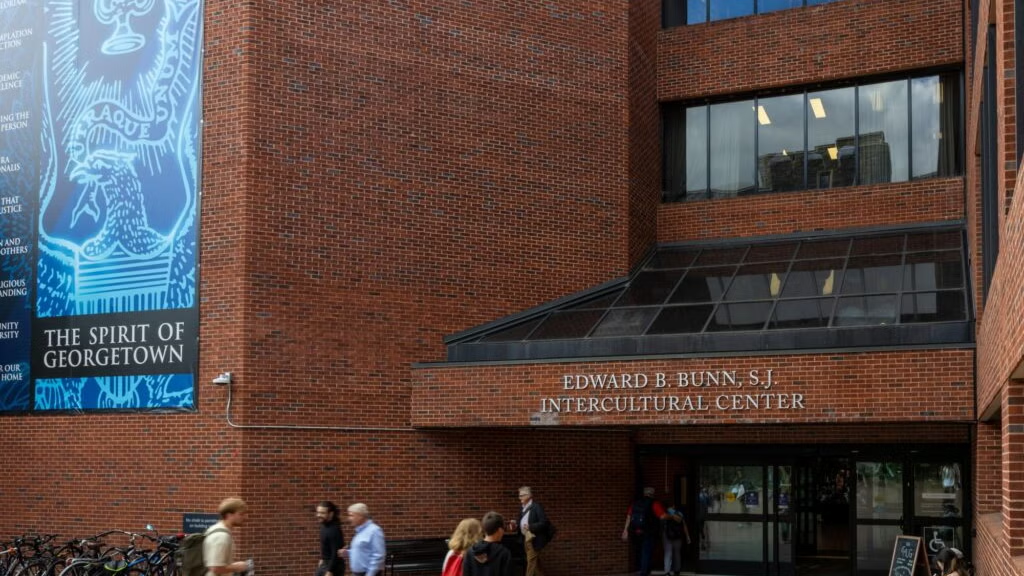
SFS to Launch Space Studies Concentration
The Georgetown University Edmund A. Walsh School of Foreign Service (SFS) approved a new space studies concentration as part of its science, technology and international affairs (STIA) program Nov. 5.
-

‘The Limit is Past the Sky’ for Ph.D. Student Seeking Extraterrestrial Life
Kenzie Mounir (G’30) is used to having to explain astrobiology to others. More often than not, she’s met with blank stares.
-
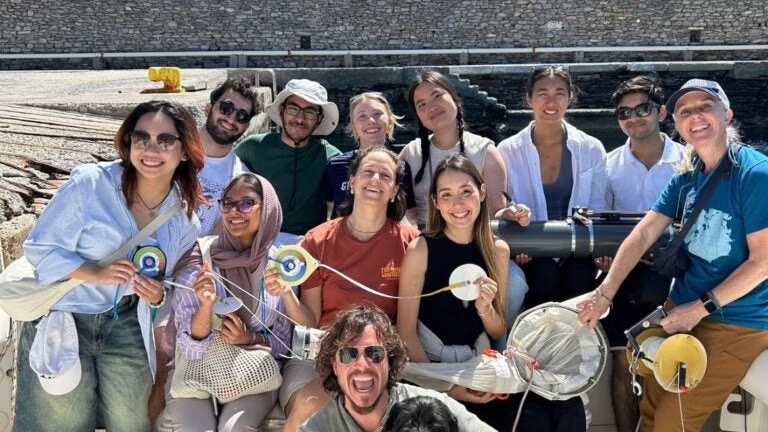
Space Detectives: Students Use Satellite Data to Address Climate Change
Summer break meant diving into marine research, hiking Greek islands, and using space tech to track climate change for rising Georgetown University in Qatar (GU-Q) juniors Adeena Hossain, Gwyneth Estomo,…